
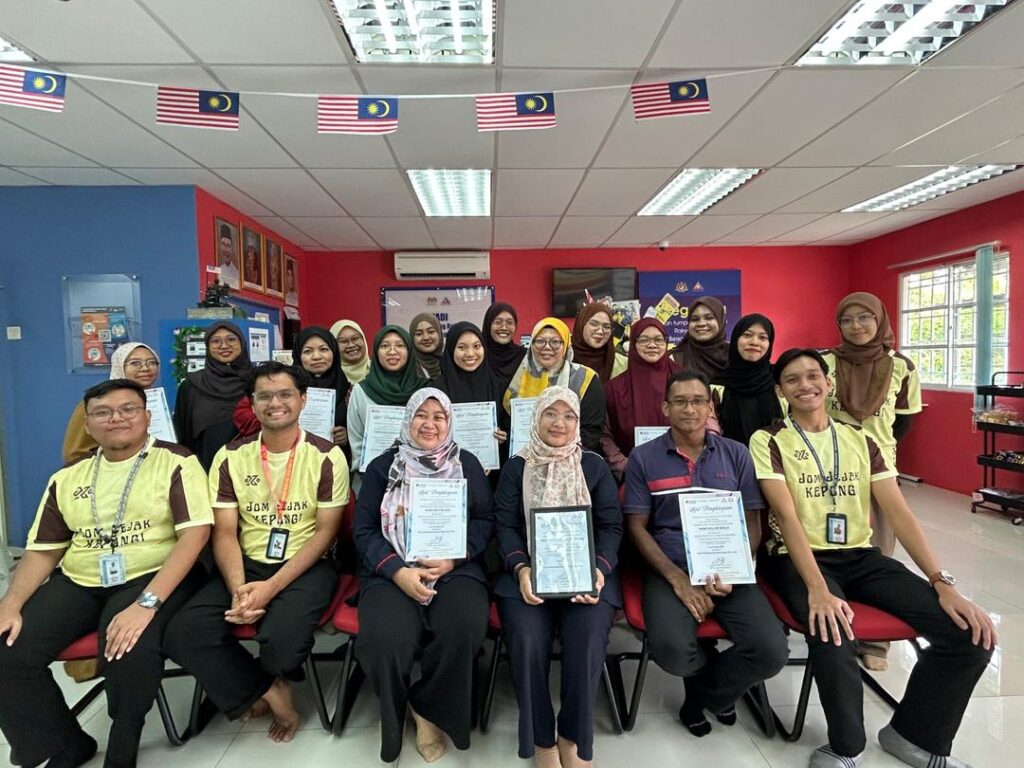
The core essence of Usrah in Action is to implement the ideas of a ‘communiversity’; a concept that centers on how university students can engage with and benefit the community around them.
To bring this idea to life, our 24-strong Usrah in Action Section 511 from the Kulliyyah of Sustainable Tourism and Contemporary Languages, led by Dr. Nur Shuhadah binti Mohd, undertook a community-based project aimed at preserving the unique culture and heritage of Mukim Bukit Kepong. This initiative, titled “Jom Jejak Kepong” sought to explore sustainable ways to document the community’s rich identity.
During the first Usrah in Action, we proposed developing a coffee table book, travel brochures, and workshops to uplift the community of Bukit Kepong. “Jom Jejak Kepong” was a success, and we brought home two awards at the 7th University in Action Symposium; the Gold Award and the Most Creative Project.
For our second Usrah in Action, we put our ideas to the test with a landmark workshop utilizing Wikimedia Commons, the internet’s most popular media repository. Driven by a belief that this platform could elevate and preserve Bukit Kepong’s identity, we set out to design a workshop that would equip locals with the skills to document their surroundings, tell their own stories, and share them with a global audience.
Drawing on previous insights gathered from site visits to Bukit Kepong where we interviewed locals and community leaders, a recurring concern came to light: the absence of proper and reliable documentation of the community’s cultural heritage and everyday life. The uniqueness of Mukim Bukit Kepong was poised to be overshadowed entirely by the incident which occured in 1950 during the Malayan Emergency. This became our sole purpose; to ensure Bukit Kepong’s identity is not confined only to an unfortunate tragedy which transpired before Malaysia’s independence, but is also recognized as the living, breathing community it is today.
With generous guidance from Wikimedia Malaysia’s team from the very beginning, we set out to design a workshop that would directly respond to these concerns. Our planning process involved several meetings with Bukit Kepong’s National Information Dissemination Center (NADI), a center established by the federal government to provide internet access to rural communities in Malaysia. We soon learned that Bukit Kepong’s NADI was not just any ordinary cybercafé; it plays an active role in community development by organizing initiatives such as free medical check-ups and educational programs for the locals. After extensive discussions, Bukit Kepong’s NADI agreed to help us in providing a suitable venue and assist in identifying suitable participants from all the villages in Bukit Kepong.
On 6th December, 2025, we departed to Bukit Kepong, a journey that took almost an hour navigating the winding backroads of rural Johor. The workshop began in the early hours of morning, attended by a total of 10 participants representing each village in Bukit Kepong. This initiative marked the first Wikimedia workshop of its kind in Malaysia, aiming to empower locals to document and share Bukit Kepong through Wikimedia Commons. The hope was that this
workshop would enable the community to elevate and preserve its local identity to a global audience.
The three-hour session received positive feedback from the participants who expressed enjoyment at the engaging activities. These included a practical photography session during which the participants took pictures of their surroundings and received step-by-step guidance on uploading their photographs to Wikimedia Commons. By the end of the workshop, the number of images under the “Bukit Kepong” category increased significantly; from just 10 images prior to the workshop to 156 photos uploaded by the locals themselves.
When asked about Wikimedia Commons and its role in preserving and disseminating knowledge through crowdsourced media, one participant highlighted its ability to bring global exposure to Bukit Kepong. Another emphasized Wikimedia Commons’ potential to contribute to local tourism by showcasing local attractions and businesses on the platform.
“Through Wikimedia, Bukit Kepong can reach a global audience,” wrote one workshop participant. “This platform can also offer a window into lives of ordinary people here.”
The workshop concluded with the launching of a vertical informational banner within Bukit Kepong’s NADI. The banner contains instructions on creating a Wikimedia account, including a scannable QR code linked to a digital manual on uploading content to Wikimedia Commons.
As the workshop wrapped up, we left with a strong sense of achievement and satisfaction. Perhaps with this initiative, Bukit Kepong’s identity can extend beyond a tragedy which happened 75 years ago. Equipped with new skills and resources, the community now has the opportunity to document their present lives, preserve its heritage, and share their narratives with the world through Wikimedia Commons.
We would like to extend our thanks to Wikimedia Malaysia for their guidance and support throughout the planning and execution of this workshop. Our appreciation also goes to the National Information Dissemination Center (NADI) Bukit Kepong, the community leaders and village chiefs, the residents of Bukit Kepong for their participation, as well as to the organizing committee and facilitators who made this initiative possible.