
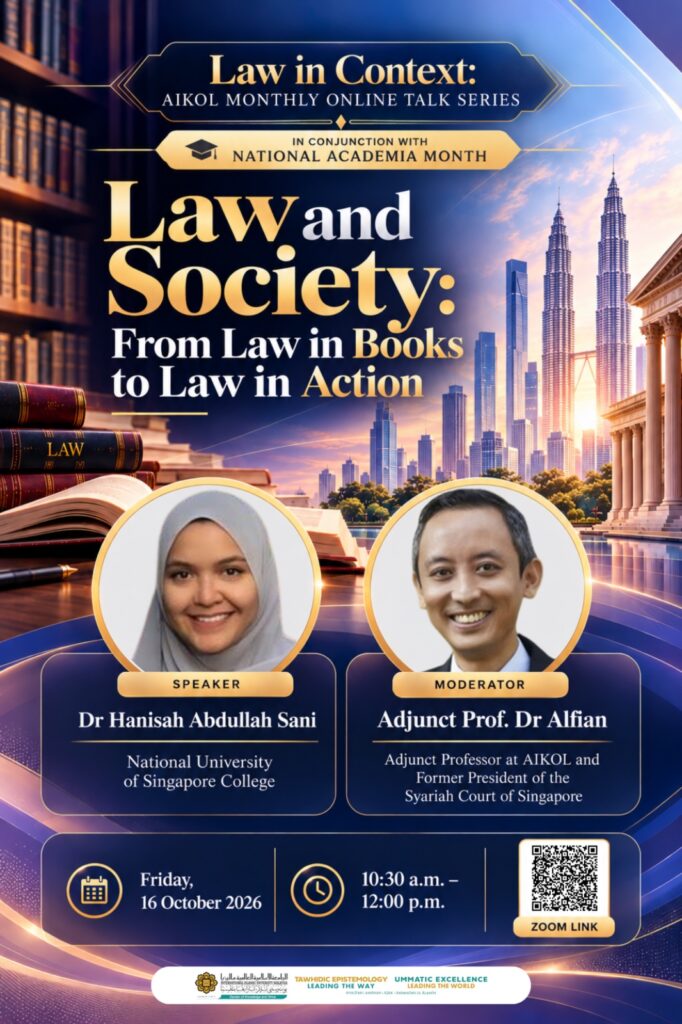
GOMBAK, 16 October 2026 – The Ahmad Ibrahim Kulliyyah of Laws (AIKOL), International Islamic University Malaysia (IIUM), launched its new Law in Context: AIKOL Monthly Online Talk Series today with an inaugural lecture entitled “Law and Society: From Law in Books to Law in Action.” The talk was held online via Zoom from 10.30 a.m. to 12.00 p.m. It was delivered by Dr. Hanisah Abdullah Sani of the National University of Singapore (NUS) College and moderated by Adjunct Professor Dr. Alfian Yasrif Kuchit, Adjunct Professor at AIKOL and former President of the Syariah Court of Singapore.
The series is organised in conjunction with National Academia Month. It aims to complement the largely doctrinal character of legal education by inviting scholars who study law from interdisciplinary perspectives. In her opening remarks, programme coordinator Dr. Siti Aliza Alias said the series seeks to ground the study of law in how it operates in society and how ordinary citizens experience it, recognising that law is shaped by history, culture, religion and literature. She also noted that the series offers a platform for regular and accessible intellectual discourse, and strengthens AIKOL’s network with scholars in the region, particularly in Singapore.
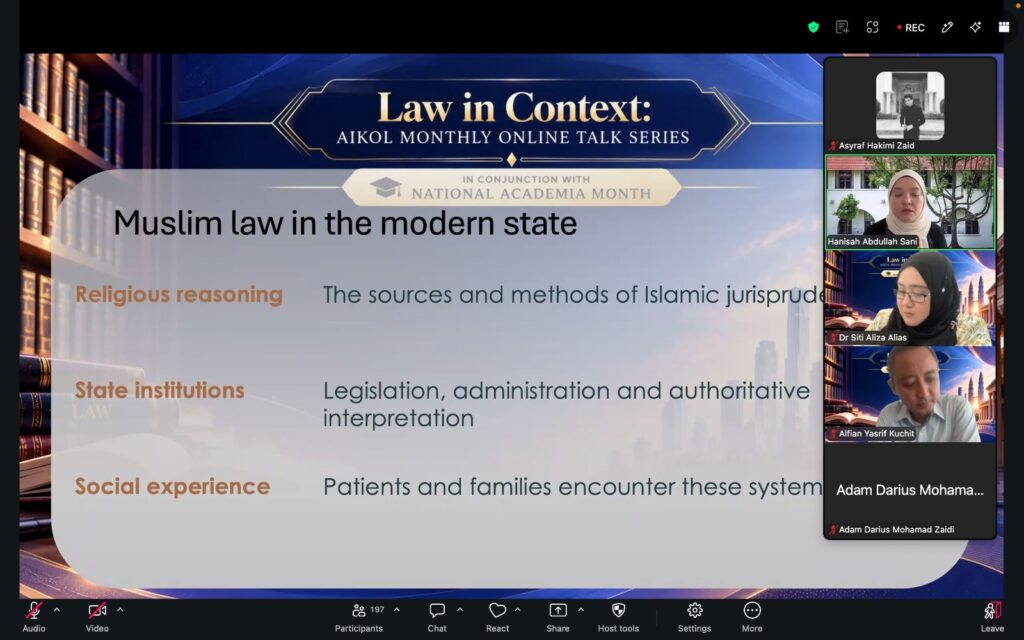
Delivering the welcoming address on behalf of the Kulliyyah, Dr. Zati Ilham Abdul Manaf, Head of the Department of Civil Law, welcomed the speaker and thanked Adjunct Professor Dr Alfian for his instrumental role in coordinating the series with colleagues from NUS.
Introducing the speaker, Adjunct Professor Dr. Alfian described Dr. Hanisah as a comparative historical and political sociologist whose research covers empire and state formation, law and religion, and the colonial and modern histories of Southeast Asia. She obtained her PhD in Sociology from the University of Chicago in 2019, held a postdoctoral appointment at the University of Michigan, and now lectures at NUS College with a joint appointment in the Department of Sociology and Anthropology. She is currently completing her first book manuscript on law, religion and state building in colonial Malaya.
In her lecture, Dr. Hanisah built on Roscoe Pound’s distinction between “law in books” and “law in action,” and on Oliver Wendell Holmes’ observation that “the life of the law has not been logic: it has been experience.” She proposed a law and society framework in which formal law is embedded in institutions, produces effects on individuals and communities, and receives those effects back as new information, in a recursive feedback process. She illustrated the framework with two Singapore case studies. The first was the inclusion of Muslims under the Human Organ Transplant Act (HOTA) following the 2007 fatwa and the 2008 amendment, which showed how a default opt-in arrangement shaped participation in practice. The second was the development of fatwas on joint tenancy and the right of survivorship in 1997, 2008 and 2019. She then discussed how Islamic jurisprudence engages with social reality through maqasid al-shariah, the jurist’s knowledge of the facts of a case, contextual interpretation and institutional amaqasid al-shariah, the jurist’s knowledge of the facts of a case, contextual interpretation and institutional analysis. Social consequences, she argued, are relevant to legal reasoning but are not self-interpretmaqasid al-shariah, the jurist’s knowledge of the facts of a case, contextual interpretation and institutional analysis. Social consequences, she argued, are relevant to legal reasoning but are not self-interpreting, and still require jurisprudential evaluation within the legal tradition.
The lecture was followed by a lively question-and-answer session. Participants raised questions on the duty of foresight of policymakers in an era of rapid technological change, the role of political will and institutions in law reform, the balance between social interests and the objectives of the Shariah, and equal access to justice regardless of social status. In her responses, Dr. Hanisah stressed that law reform should not be viewed as solely state-centric. She highlighted the importance of legal consciousness and basic legal literacy within society, and encouraged future lawyers to promote legal access through community and pro bono work, such as public awareness on wills and estate planning.
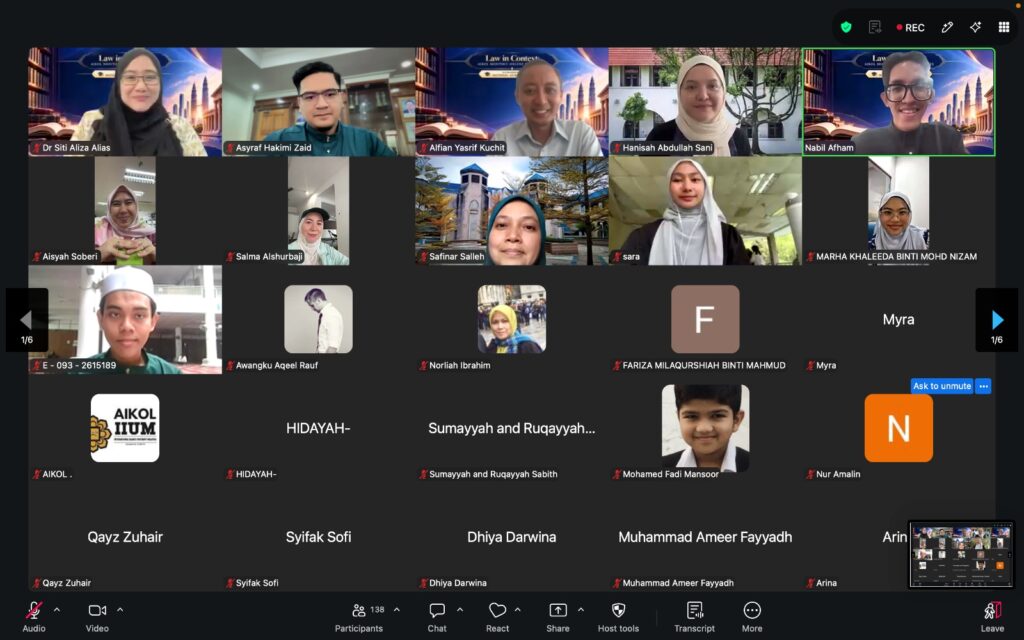
The session ended with closing remarks by Dr. Siti Aliza and a virtual group photograph. The next session in the series will be held on 13 November 2026 and will feature Dr. Azhar Ibrahim of NUS, who will speak on Malay customary law and tradition.
Through this series, AIKOL reaffirms its commitment to an interdisciplinary and socially grounded legal education, and to deepening its academic engagement with scholars across the region.