
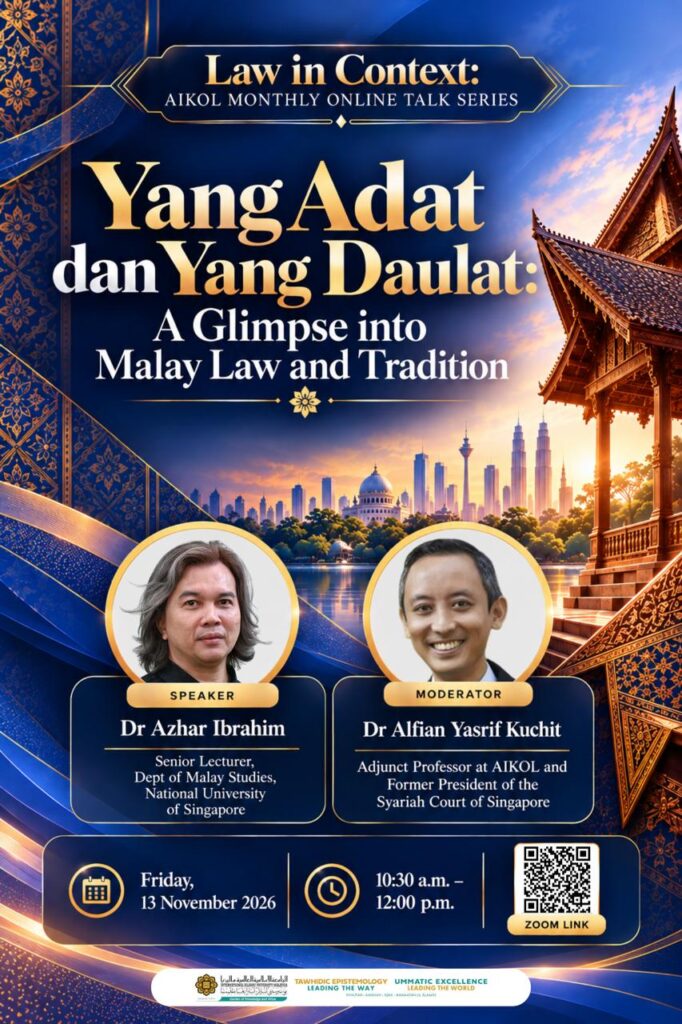
GOMBAK, 13 November 2026 – The Ahmad Ibrahim Kulliyyah of Laws (AIKOL), International Islamic University Malaysia (IIUM), held the second session of its Law in Context: AIKOL Monthly Online Talk Series today, entitled “Yang Adat dan Yang Daulat: A Glimpse into Malay Law and Tradition.” The talk was held online via Zoom from 10.30 a.m. It was delivered by Dr. Azhar Ibrahim, Senior Lecturer at the Department of Malay Studies, National University of Singapore (NUS), and moderated by Dr. Alfian Yasrif Kuchit, Adjunct Professor at AIKOL and former President of the Syariah Court of Singapore.
In her introduction and welcoming remarks on behalf of the Kulliyyah, programme director Dr. Siti Aliza Alias recalled that the series seeks to complement the largely doctrinal character of legal education by examining how law operates in society and how it is shaped by history, culture, religion and literature, through monthly talks by scholars who study law from interdisciplinary perspectives. She said the session brought the series closer to “our own experience and tradition,” and encouraged students, particularly second-year Constitutional Law students, to engage with the speaker.
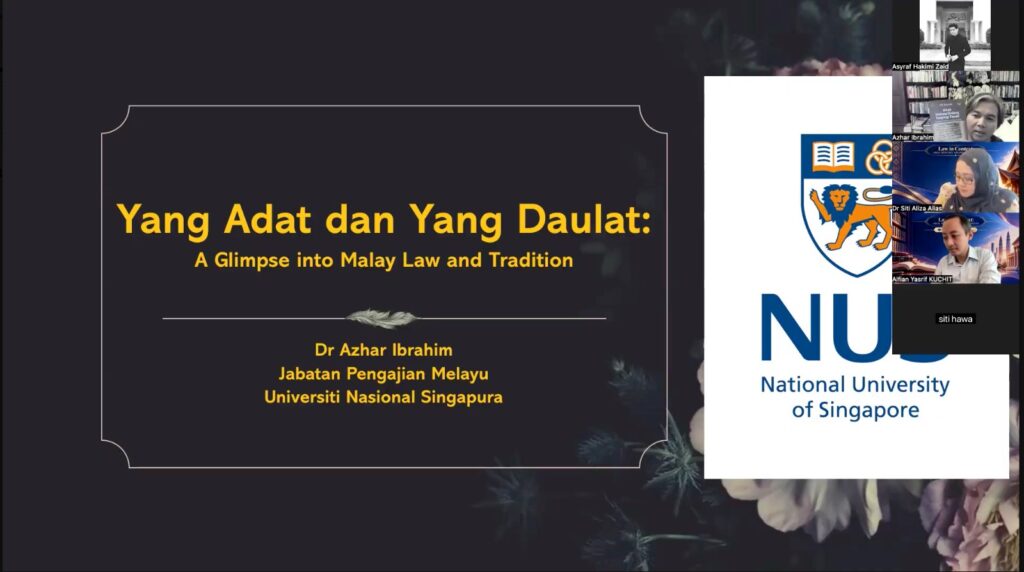
Introducing the speaker, Dr. Alfian described Dr. Azhar as a scholar whose interests span Malay and Indonesian literature, sociology, Islamic thought, social theology, critical literacy and the intellectual history of Malay and Indonesian societies. Dr. Azhar obtained his PhD in Malay Studies from NUS in 2008, undertook postdoctoral research at the University of Copenhagen and has been a visiting scholar at Stanford University. He is Deputy Chairman of the Malay Language Council of Singapore, Chairman of the Malay Advisory Panel of the National Library Board and a former Vice-Chairman of the Malay Heritage Foundation.
In his opening reflections, Dr. Alfian linked the session to the inaugural lecture, noting that to understand law in action one must also understand law in context. He observed that adat is not only a matter of wedding customs and taboos, but historically regulated the relationship between rulers and subjects, rights and responsibilities, property and inheritance, and the settlement of disputes, as reflected in Malay legal digests such as the Hukum Kanun Melaka and Hukum Kanun Brunei. He added that custom continues to find a place in modern law, pointing to Article 160(2) of the Federal Constitution, which includes “any custom or usage having the force of law” within the definition of “law,” and raised questions on when custom acquires legal force and how courts prove its existence and content.
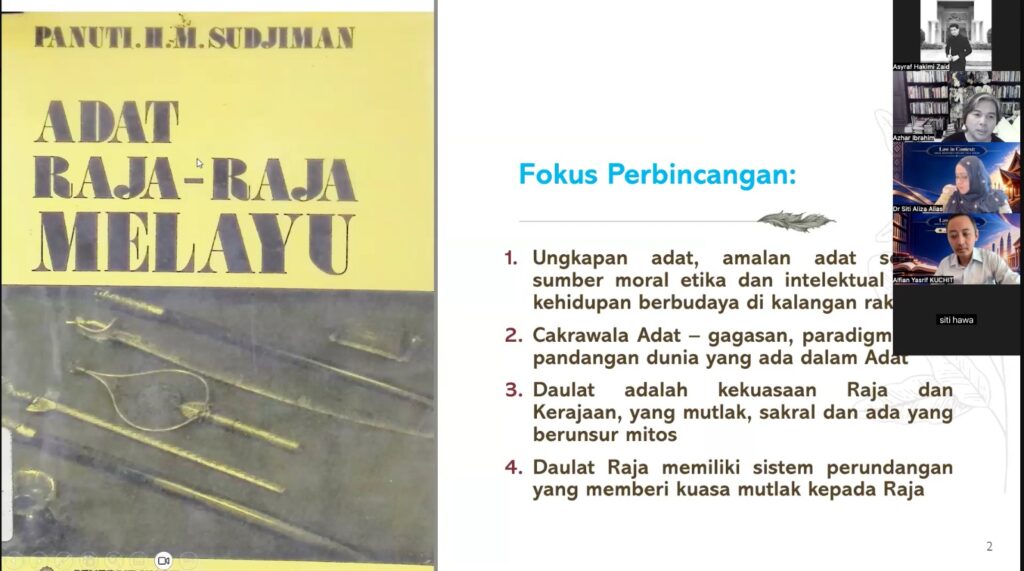
In his lecture, Dr. Azhar began with the Undang-Undang Tanjung Tanah, which he described as among the oldest Malay manuscripts, to show that law has long been central to the Malay textual tradition. He examined adat and daulat as two distinct but interrelated idioms of authority. Daulat, derived from the Arabic daulah, refers to the sacred and absolute authority of the ruler and served as a legitimating ideology of the court, expressed in classical texts such as the Sulalatus Salatin through notions such as the sultan as the shadow of God. Adat, by contrast, is found both within the court and among the people, and was often transmitted orally.
Dr. Azhar distinguished several senses of adat: the customs and regulations of rulers recorded in legal digests and kanun; the social norms that sustain communal harmony; and ancestral custom, as seen in the contrasting adat perpatih and adat temenggung traditions, the former more flexible and associated with less complex agrarian societies, the latter firmer and associated with more cosmopolitan coastal polities. He also highlighted adat as a repository of ethical wisdom conveyed through proverbs, such as “adat menimbang sama berat, adat mengukur sama panjang,” which emphasise fairness, moderation and humanity, and discussed its relationship with Islam as captured in the maxim that adat is founded on syarak and syarak on the Book of Allah. He suggested that adat should be understood not merely as an instrument legitimising daulat, but also as a source of ethics, ideals and legal imagination, and reminded participants that the pen is mightier than the sword.
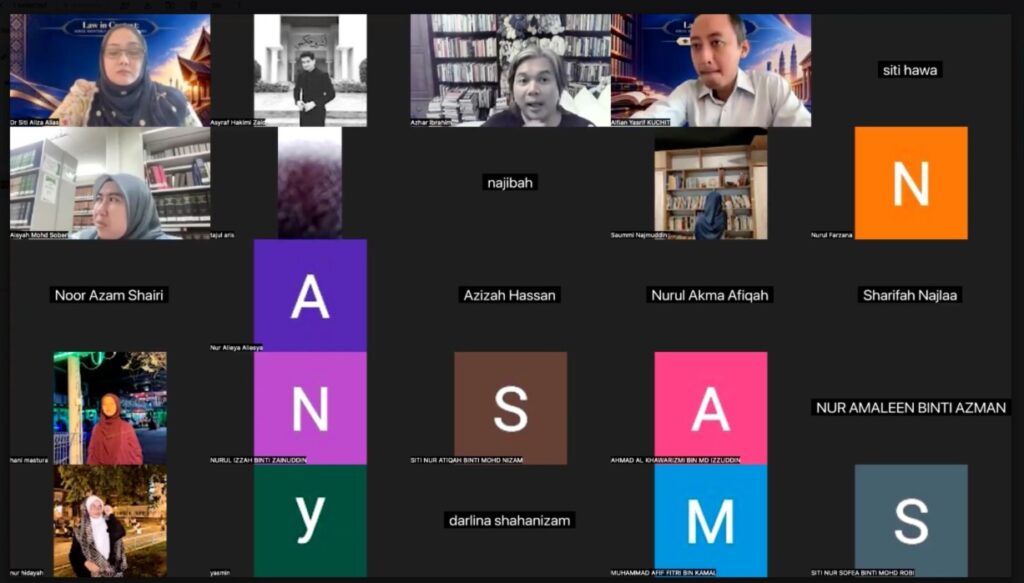
The lecture was followed by a lively question-and-answer session. Participants raised questions on the interaction between adat and Islamic law, including the Islamisation of customary practices; the notion of a social contract between ruler and subjects in the Sulalatus Salatin; and whether cultural values of loyalty to rulers leave society vulnerable to abuse of power. In response, Dr. Azhar stressed that loyalty must be balanced by accountability, and that leaders must remain answerable for their conduct.
In her closing remarks, Dr. Siti Aliza observed that the speaker’s emphasis on cultural saying akin to that of “the pen over the sword” aligns with the principle of the rule of law as distinct from rule by law, and she emphasised that, with all things, at the end of the day everything must be approached with moderation, to achieve a balanced society where both sides (ruler and subjects) can live harmoniously in a fair and just society. Lastly she remarked that engaging with Malay legal and cultural traditions offers students a valuable perspective beyond doctrinal study. She thanked Dr. Azhar, Dr. Alfian and all participants for a fruitful discussion.
The Law in Context series continues on a monthly basis, with details of upcoming sessions to be announced. Through this series, AIKOL reaffirms its commitment to an interdisciplinary and socially grounded legal education, and to deepening its academic engagement with scholars across the region.